

As Childhood Cancer Awareness Month heats up, you’ll undoubtedly see people #GoGold and raising awareness for childhood cancer.
We’re locking arms with organizations across the country to shine a light not only on the strength and struggles of kids and families fighting cancer, but also to examine the research, science, and political issues that enable or restrict advances.
The National Cancer Institute —the government agency that is responsible for research and education— receives a $6.44 billion budget (2020). The NCI parses that budget to a lot of incredibly important projects. Every cancer sucks, and every cancer is deserving of research, but frankly, kids are getting ripped off. Only 4% of the NCI budget is directed to pediatric cancer. Yes, allpediatric cancers combined (brain cancer, leukemia, lymphoma, neuroblastoma, bone and tissue etc.). Four percent of the NCI budget shakes out to be about 250 million dollars. That seems like a big number, until you think about how long, meticulous, and expensive cancer research is. (And did we mention that’s the budget for all childhood cancers combined?)
So, we decided to let our rage lead us down a research rabbit hole to see just how the US’s Investment in our children stacks up to investments in… other things.
Take a closer look at where we choose — as a country* — to invest:
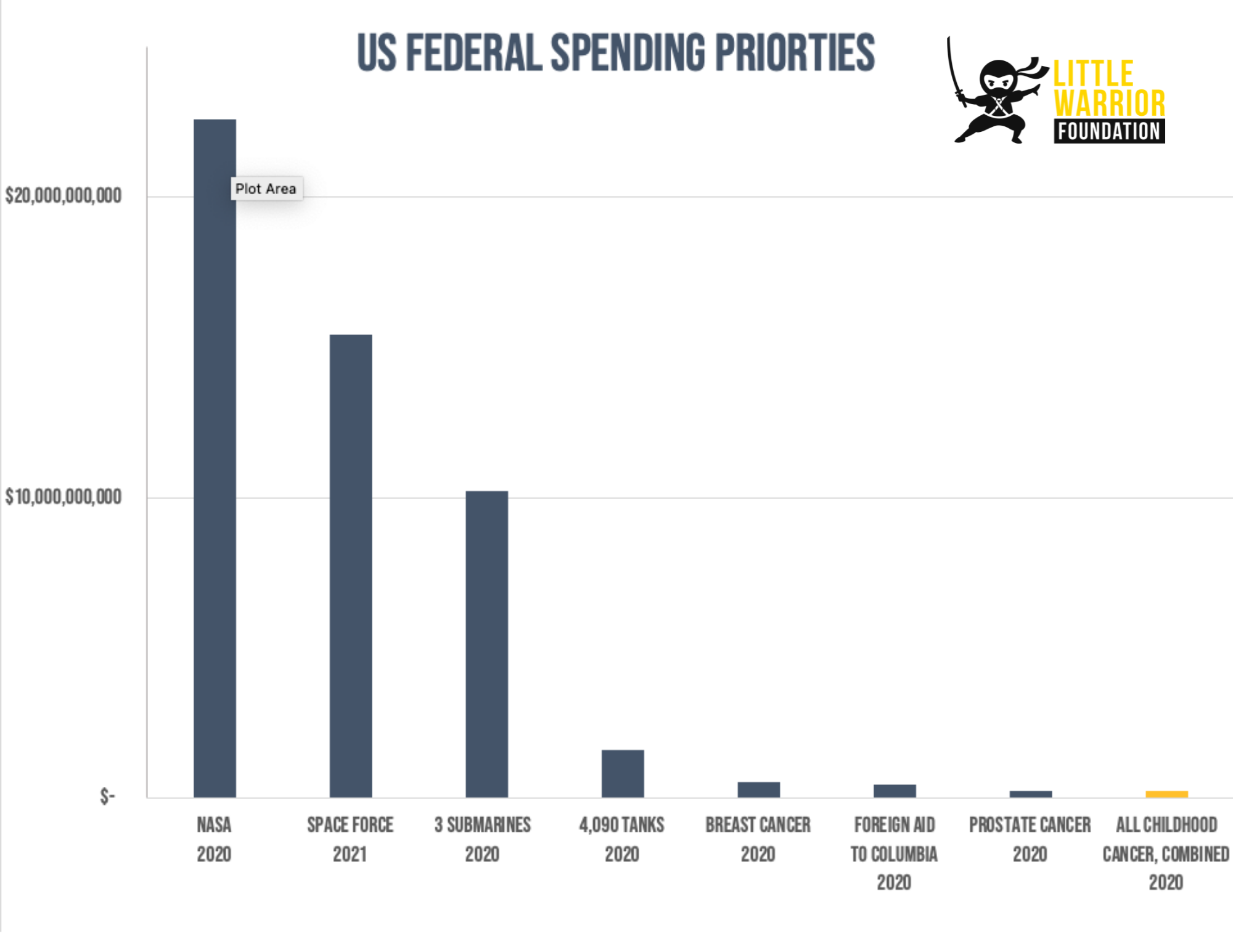
Shaving just 1% of the 2020 NASA budget could DOUBLE the childhood cancer investment.
It would take 70 years of childhood cancer spending to match one year of Space Force Funding.
Just one submarine-worth of funding could advance pediatric cancer research by 15 years.
And what on earth is happening in Columbia that it gets 2x the funding of all pediatric cancers combined?
To be clear, we’re not saying that those giant investments aren’t for important initiatives. (Although, it’s frankly terrifying that we suddenly need to beef up our planetary defense THAT much. What’s really going on at Area 51!?) We’re big fans of space exploration and all the important science and breakthroughs that trickle down when a Space Program is really rocking. But there are little earthlings that can’t wait for “trickle down” anything. They need modern, more-effective, less-toxic therapies and alternatives… now. In fact, they needed them decades ago.
Patients, families and communities are stepping up to try to fill the gap. One incredible warrior, Megan Bugg, just hosted a garage sale to fund research for Rhabdomyosarcoma — a garage sale. One of our peer organizations started as a lemonade stand run by a 4-year-old named Alex who bravely battled Neuroblastoma. Maybe we should ask the astronauts to sell t-shirts and bracelets to fund their missions. It’s no more ludicrous than kids having bake sales to fund a cure for their cancer. The point is, the funding need and research gap is so vast and while we’re all trying to fill it — we could use some help at the federal level.

Now, if you got this far and you’re thinking: “Maybe this doesn’t tell the whole story — What about the pharmaceutical industry? Certainly, they are funding a lot of advancements, right?” Well, we hoped that was the case too -- but the answer is a firm NO. We’ll tackle that beast of a topic in an upcoming post, but Big Pharma has left these kids in the dust.
If you agree that all of this is unacceptable, we urge you to help spread awareness for Childhood Cancer and the need for more federal funding. Here are some ideas for how you can get involved:
Ask your elected officials to advocate for more funding. Our friends at Truth365 make it super easy.
Share this post, or other posts that shine a light on the problem.
Donate if you can. You can donate to our Foundation, or to Megan Bugg - the garage sale godess, or any of the thousands of reputable 501(c)3 non-profits trying to bootstrap a cure. We’re all in this battle together.
We have to do better for these kids. They are worth #MoreThan4.
*While this is a snapshot of our spending for the past 1-2 years, these trends have been pretty consistent for decades. We’re not criticizing any one politician or political party. We’re criticizing all of ‘em.
SOURCES:
NCI Budget: National Cancer Institute, NCI Budget And Appropriations
NASA 2020 Budget: National Aeronautics And Space Administration FY 2020 Spending Plan For Appropriations Provided By P.L. 116-93 and P.L. 116-136
Space Force 2021 Budget: United States Department of Defense Budget Request
Submarine Budget:United States Department of Defense Budget Request
Tank Budget: United States Department of Defense Budget Request Breast Cancer Federal Funding:National Cancer Institute: NCI Budget And Appropriations
Columbia Foreign Aid: US State Department: USAID.gov
Prostate Cancer Federal Funding:zerocancer.org: Prostate Cancer Research Funding
Childhood Cancer Funding:NIH/NCI Budget